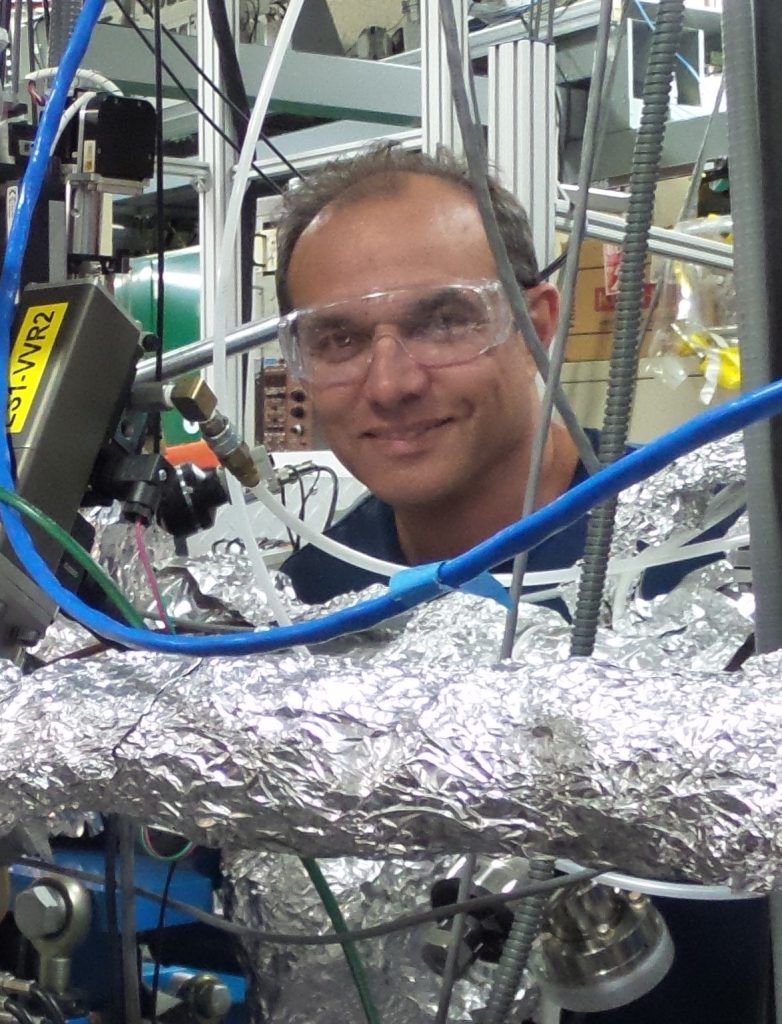
Lennie Klebanoff is a Principal Member of the Technical Staff in the Combustion Research Facility at Sandia National Laboratories. He leads challenging R&D efforts that solve important problems in H2 storage, H2 fuel-cell applications, semiconductor technology and other areas of vital national interest.
Education
Bachelor of Science (B.S.) in Chemistry, Bucknell University
Masters in Science (M.S.) in Organic Chemistry, Bucknell University
Doctor of Philosophy (Ph.D.) in Physical Chemistry, University of California, Berkeley
Selected Awards and Honors
2024 Editor’s Choice Award, International Journal of Hydrogen Energy, for “Impactful Research for 2024,” for “Exploring Liquid Hydrogen Tank Technology for Zero-emission Fuel Cell Vessels,” Int. J. of Hydrogen Energy 80 (2024) 1441 – 1465.
2024 “75 Ways Sandia Has Changed the Nation,” entry # 50 for “Next Generation Electronics EUV Lithography Project” and entry # 63 for “Hydrogen Fuel Cells Applied to Maritime Vessels.”
2020 Federal Laboratory Consortium National Award, Excellence in Technology Transfer Award.
2017 Sandia Employee Recognition Award for Individual Technical Excellence.
2011 Rental Equipment Magazine“Grand Prize for Innovative Technology,” for Fuel Cell Mobile Light.
2011 DOE Hydrogen and Fuel Cells Program R&D Award,“In recognition of outstanding contributions to Fuel Cell Market Transformation Activities.”
2011 US Congress Certificate of Special Recognition, 2011 Dream Makers and Risk Takers Award Winner, “in recognition of outstanding and invaluable service to the community,” for the Fuel Cell Mobile Light Project.
2010 DOE Hydrogen Program Special Recognition Award,“In Recognition of Outstanding Contributions to the Department of Energy.”
Webinars for the World Hydrogen Energy Conference (EnergyBizNews), 2024 – 2025: H2 Storage, H2 Vessels, H2 Technology Q&A, and H2 Safety.
H2 Technical Advisor:U.S. DOE (2006 – present), DOT (2015 – 2026), Scripps Institution of Oceanography (2018 – 2026), United States Coast Guard (2015 – present), Class Societies worldwide (2015 – 2026).
Editor-in-Chief and Co-author of Six Chapters for CRC Press book: “Hydrogen Storage Technology, Materials and Applications,” published December 11, 2012.
Selected Publications
Hydrogen Storage:
“Decoding the Desorption Mechanism of 2LiH:1Mg(NH2)2 Using Metal Borohydrides,” ACS Appl. Energy Mater. 8 (2025) 10379 – 10391. https://doi.org/10.1021/acsaem.5c01297
“A Bulk Versus Nanoscale Hydrogen Storage Paradox Revealed by Material System Co-Design,” Adv. Funct. Mat. (2024) 2411763 1-10. https://doi.org/10.1002/adfm.202411763
“Understanding Electronic Structure Tunability by Metal Dopants for Promoting MgB2 Hydrogenation,” J. Appl. Physics 135 (2024) 025003 1-11. https://doi.org/10.1063/5.0175546
“Progress, Challenges and Opportunities in the Synthesis, Characterization, and Application of Metal-Boride-Derived Two-dimensional Nanostructures,” ACS Materials Lett. 3 (2021) 535-556. https://doi.org/10.1021/acsmaterialslett.1c00086
“Nanointerface-driven Reversible Hydrogen Storage in the Nanoconfined Li-N-H System,” Adv. Mat. Interfaces 4, 1600803 (2017).
“A Comparative Analysis of the Cryo-compression and Cryo-adsorption Hydrogen Storage Methods,” Int. J. of Hydrogen Energy 39, 10564 (2014). https://doi.org/10.1016/j.ijhydene.2014.04.200
“5 Years of Hydrogen Storage Research in the U.S. DOE Metal Hydride Center of Excellence (MHCoE),” Int. J. of Hydrogen Energy 38 (2013) 4533-4576. https://doi.org/10.1016/j.ijhydene.2013.01.051
Hydrogen Fuel Cell Technology and Market Transformation:
“Developing Refueling Protocols for 250 bar Hydrogen Tanks Onboard Hydrogen Ferries: Experiments and Modeling,” Int. J. Hydrogen Energy 217 (2026) 153768. https://doi.org/10.1016/j.ijhydene.2026.153768
“Design and Permitting Considerations of a Floating Hydrogen Production and Distribution Barge for the Port of San Francisco,” Int. J. of Hydrogen Energy 138 (2025) 938 – 957. https://doi.org/10.1016/j.ijhydene.2025.05.149
“MV Sea Change: The First Commercial 100% Hydrogen Fuel Cell Passenger Ferry in the World,” Int. J. of Hydrogen Energy 105 (2025) 389 – 404. https://doi.org/10.1016/j.ijhydene.2025.01.040
“Exploring Variations in the Weight, Size and Shape of Liquid Hydrogen Tank Technology for Zero-emission Fuel Cell Vessels,” Int. J. of Hydrogen Energy 80 (2024) 1441 – 1465. https://doi.org/10.1016/j.ijhydene.2024.06.420
“Predicting Radiation-induced Carbon Contamination of EUV Optics,” J. of Vac. Sci. and Tech. B 37 021602 (2019). https://doi.org/10.1116/1.5072797
“Modeling Radiation-Induced Carbon Contamination of Extreme Ultraviolet Optics,” J. of Vac. Sci. and Tech. B 24, 64 (2006). https://doi.org/10.1116/1.2140005