Search

Results 111–120 of 130

Sandians develop new Theory-Informed Kinetics Model

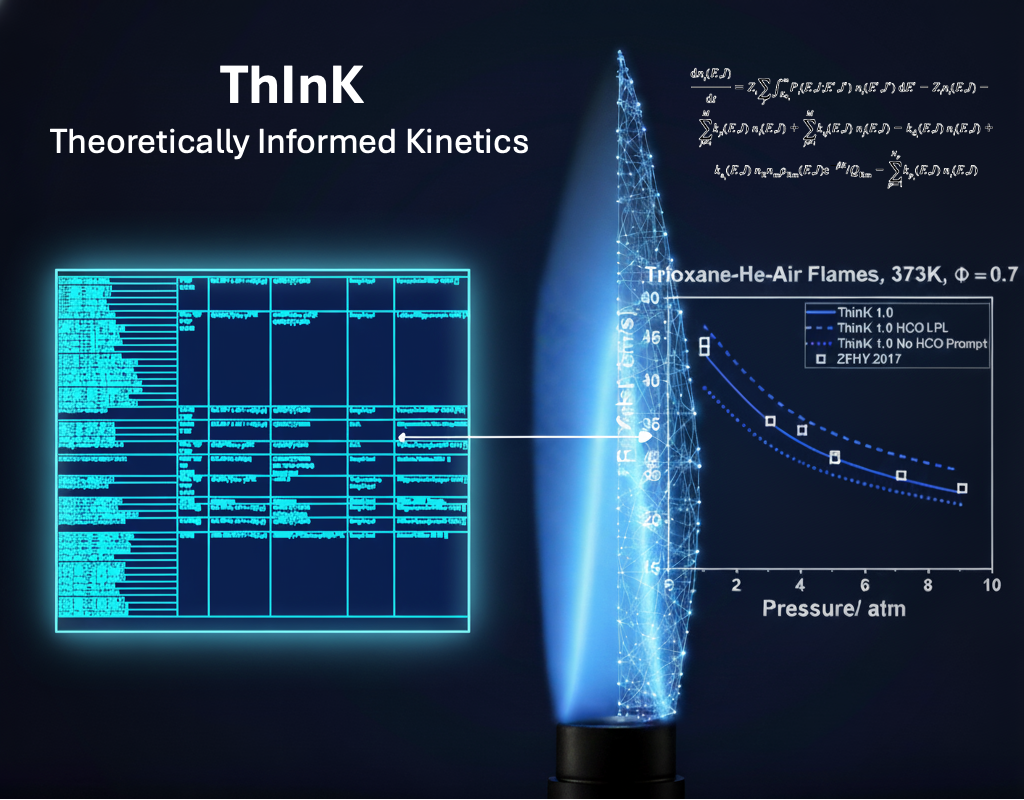
Post, November 25, 2025 • CRF researchers, along with colleagues from Argonne National Laboratory, University of Colorado Boulder, Southeast University Nanjing, Columbia University, Polytecnico Milano, Brown University, Baylor University, and the Technical University of Denmark, have developed a theory-informed kinetics model (ThInK) for the small molecule chemistry (H2 and C1 – C3 species) that forms...
Spatially and Temporally Resolved Diagnostics

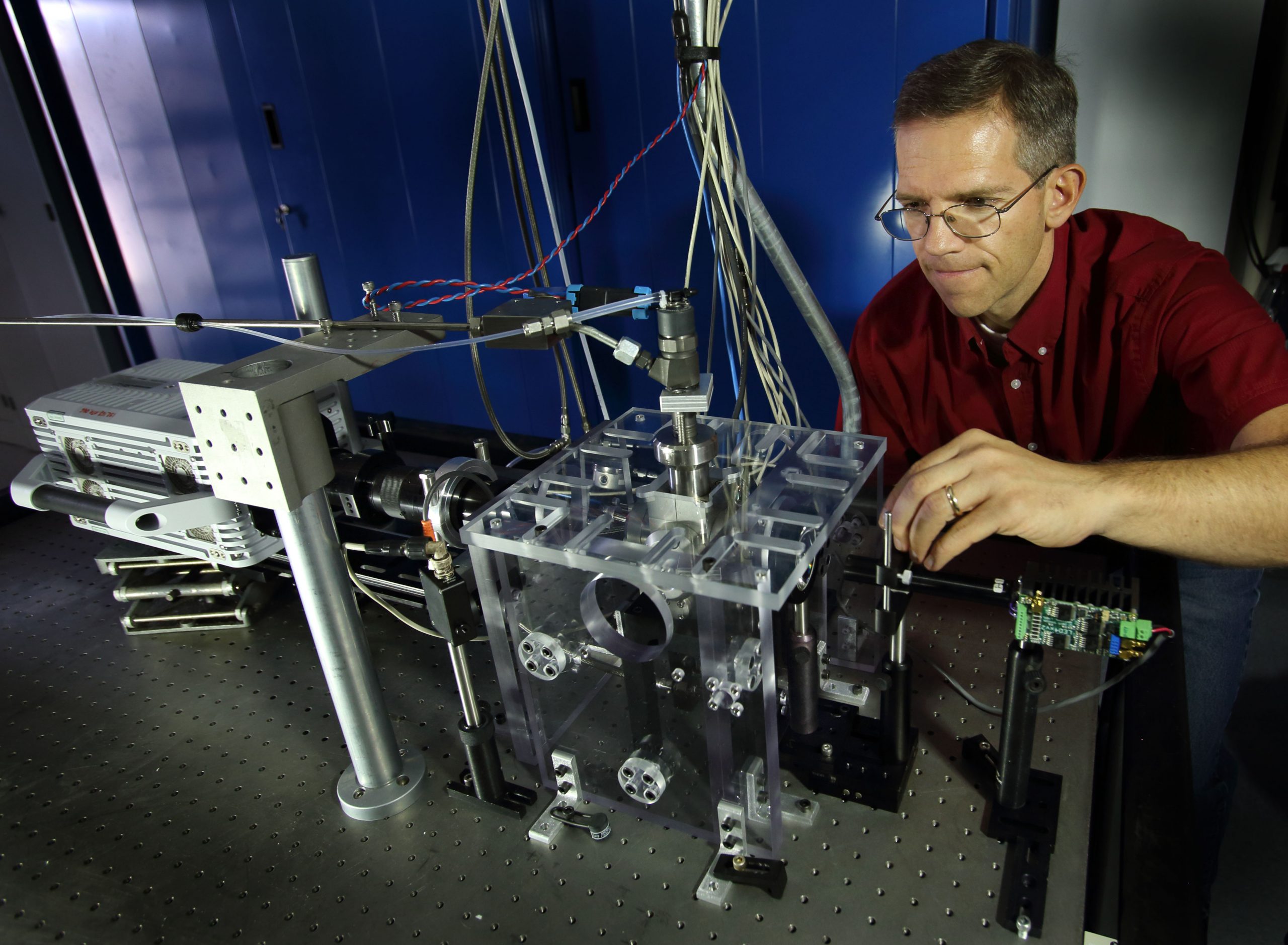
Page • Understanding complex chemical physics systems often involves correlations among properties, making multidimensional diagnostics a natural tool. The CRF invents and employs imaging methods to probe such correlations: from ion imaging, which directly measures correlated angular and velocity distributions in single molecular collisions or photodissociation to four-dimensional imaging of chemical processes...

Spectroscopy and Light-Matter Interactions

Page • CRF researchers have made breakthroughs that support chemical physics research in areas such as non-linear spectroscopy, ion imaging, 3-dimensional optical imaging, multiplexed photoionization/photoelectron spectroscopy, and x-ray absorption and scattering. Some of the resulting capabilities are described in the Experimental Capabilities section. Many of these breakthroughs are based in fundamental research...

Sponsors & Partnerships

Page • The CRF pursues collaborations with industry, academia, and government to conduct leading-edge research that helps the U.S. Department of Energy meet national goals, one of which is to help industry resolve challenging technical issues that, in turn, can impact U.S. economic competitiveness. Sponsors Several U.S. Department of Energy program areas...

Spray Combustion Consortium formed to improve engine design

Post, January 13, 2017 • by Michael Padilla Sandia National Laboratories has formed an industry-funded Spray Combustion Consortium to better understand fuel injection by developing modeling tools. Control of fuel sprays is key to the development of clean, affordable fuel-efficient engines. Intended for industry, software vendors and national laboratories, the consortium provides a direct path...

Spray Combustion Laboratories

Page • Fuel spray injection will be a key element for enabling high-efficiency, low-emission engines of the future. Understanding the spray combustion process is critical, however, investigating engine combustion processes is challenging due to factors affecting the in-cylinder environment where mixing with fuel sprays occurs. The temperature, pressure, density, and composition of...

Stochastic Systems

Page • Stochastic models are useful in chemical modeling at intermediate scales. Our work in this area includes the development of numerical methods for dealing with stiffness in the chemical Langevin equation and in kinetic Monte Carlo models. Stiffness in Stochastic Chemical Models We have developed time integration strategies that target efficient...

Tandem Mass Spectrometry

Page • Although a powerful technique, analyzing molecules based on mass does not always enable us to identify specific molecular structures. Photoionization spectroscopy can yield isomer-specific information from mass spectrometry, but as the molecules grow larger in the chemistry leading to soot formation, for example, the photoionization spectra are no longer diagnostic....

Theoretical Chemistry

Page • Project/Program Description We use electronic structure methods, master equations, and molecular dynamics to explore and interpret transformations at the atomic scale in molecular systems. Impact Statement Figure 1 The potential energy surface of the acetylene + acetylene reaction. We are interested in chemical reactions and structural changes in molecules initiated...

Tim Zwier Awarded Miguel Catalán Medal

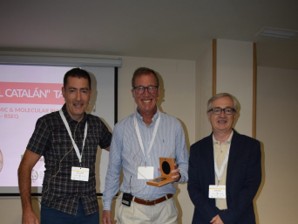
Post, September 17, 2025 • Tim Zwier, was awarded the Miguel Catalán Medal at the XVIII Iberian Joint Meeting on Atomic and Molecular Physics, July 21-24, 2025 in Vigo, Spain The medal, named for Prof. Miguel Catalán (1894-1957), honors a scientist for exceptional contributions and research record in the field of Atomic and Molecular Physics....
Results 111–120 of 130