
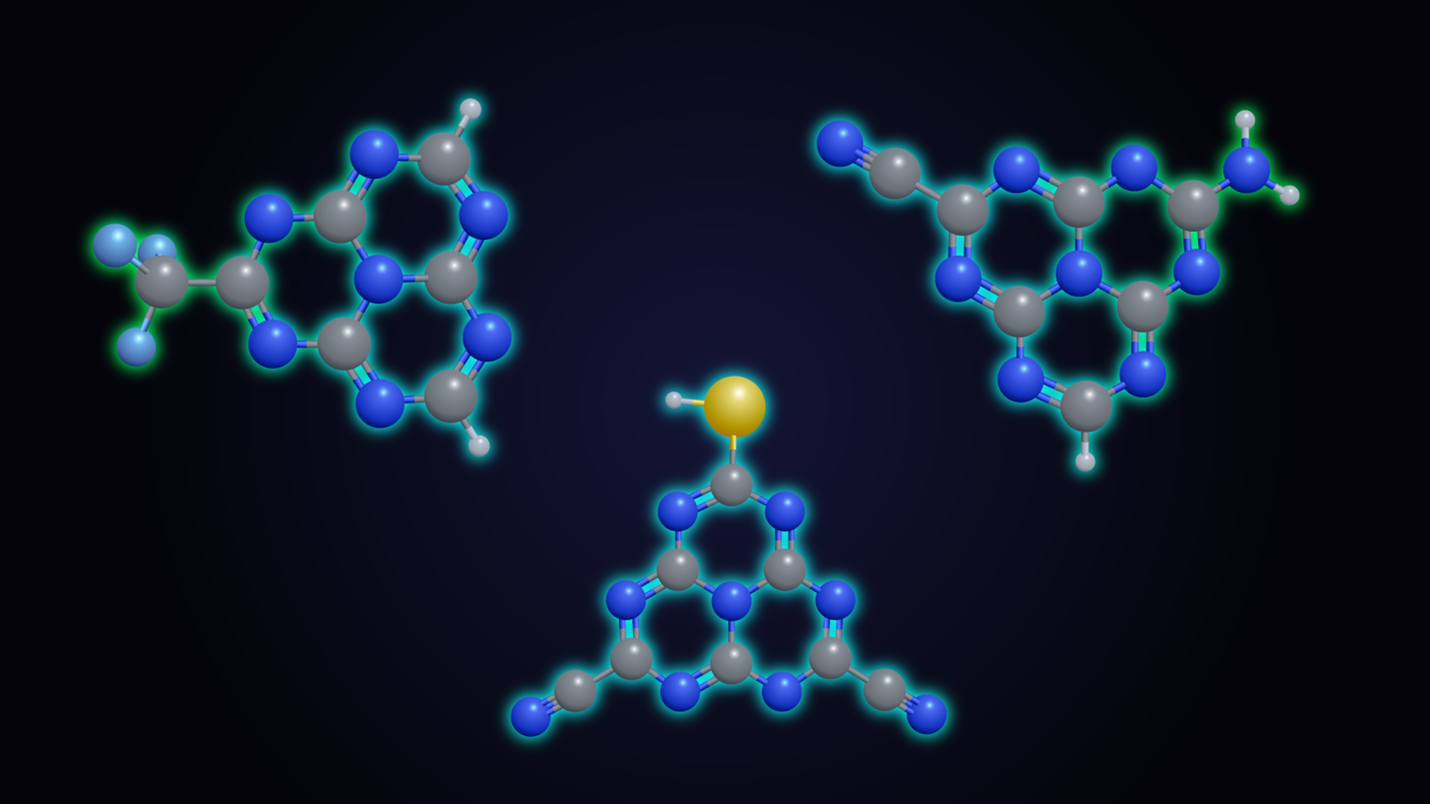
Laura McCaslin, CRF postdocs Varun Rishi and Ali Abou Taka and Hrant Hratchian (UC Merced), published a paper in “The Journal of Physical Chemistry Letters” on “Quantifying Design Principles for Light-Emitting Materials with Inverted Singlet–Triplet Energy Gaps.”
Most organic light-emitting materials lose efficiency because 75% of excitons are non-emissive triplets. So-called INVEST materials are different—they have a “reversed” energy ordering that allows triplet states to convert back into light-emitting singlet states through a process called reverse intersystem crossing. This paper explores what structural features of molecules promote this inverted energy ordering and demonstrates a strong linear correlation between the inverted singlet-triplet energy gap and two computable electronic descriptors: the degree of intramolecular charge transfer and the deviation from single-excitation wavefunction character. These reliable, physically meaningful correlations provide a mechanistic foundation for understanding complex substitution effects and precisely tuning the gap magnitude in heptazine-based systems. Ultimately, these findings pave the way for machine-learning (ML) approaches to rapidly predict the singlet -triplet energy gap without requiring demanding, high-level quantum chemistry calculations, significantly accelerating the rational design of next-generation organic light-emitting applications.
J. Phys. Chem. Lett. 2025, 16, 21, 5213 – 5220 https://doi.org/10.1021/acs.jpclett.5c00827