
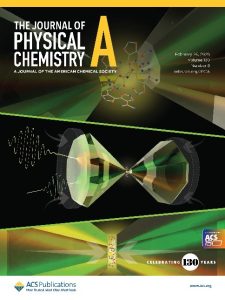
CRF researchers Daniel Carlson, Paul Schrader, Kendrew Au, and Krupa Ramasesha, together with River Leversee from CU Boulder and Sandia colleagues Neil Cole-Filipiak, Robert Knepper, and Mitchell Wood, have employed ultrafast spectroscopic tools to probe the detailed energy flow that determines initiation processes in energetic materials. Their work is highlighted in an invited perspective paper in The Journal of Physical Chemistry A entitled “New Perspectives on Vibrational Energy Transfer in Energetic Materials. Insights from Pressure-Tuned Ultrafast Spectroscopy”.
In this feature article, the authors highlight their recent efforts employing ultrafast broadband infrared spectroscopy toward understanding the interplay between molecular and lattice vibrations in energetic materials, motivated by the open questions surrounding the role of vibrational energy transfer (VET) in reaction initiation in these materials. Their work addresses the ongoing debate on the participation of doorway modes in VET. They further present new results from high-pressure ultrafast experiments on RDX, a hydrogen-bonded material, and BNFF, a hydrogen-free material, to explore how intermolecular interaction strength governs VET pathways and time scales. Collectively, their findings reveal that vibrational dynamics in these systems occur across three distinct time regimes, with VET being incomplete out to hundreds of picoseconds, suggesting the importance of considering nonstatistical reactions in the modeling of these materials. Their results shed light on how intermolecular interactions shape vibrational energy redistribution in molecular materials and highlight the need for further theoretical and experimental investigation.
For more details: https://doi.org/10.1021/acs.jpca.5c07814