
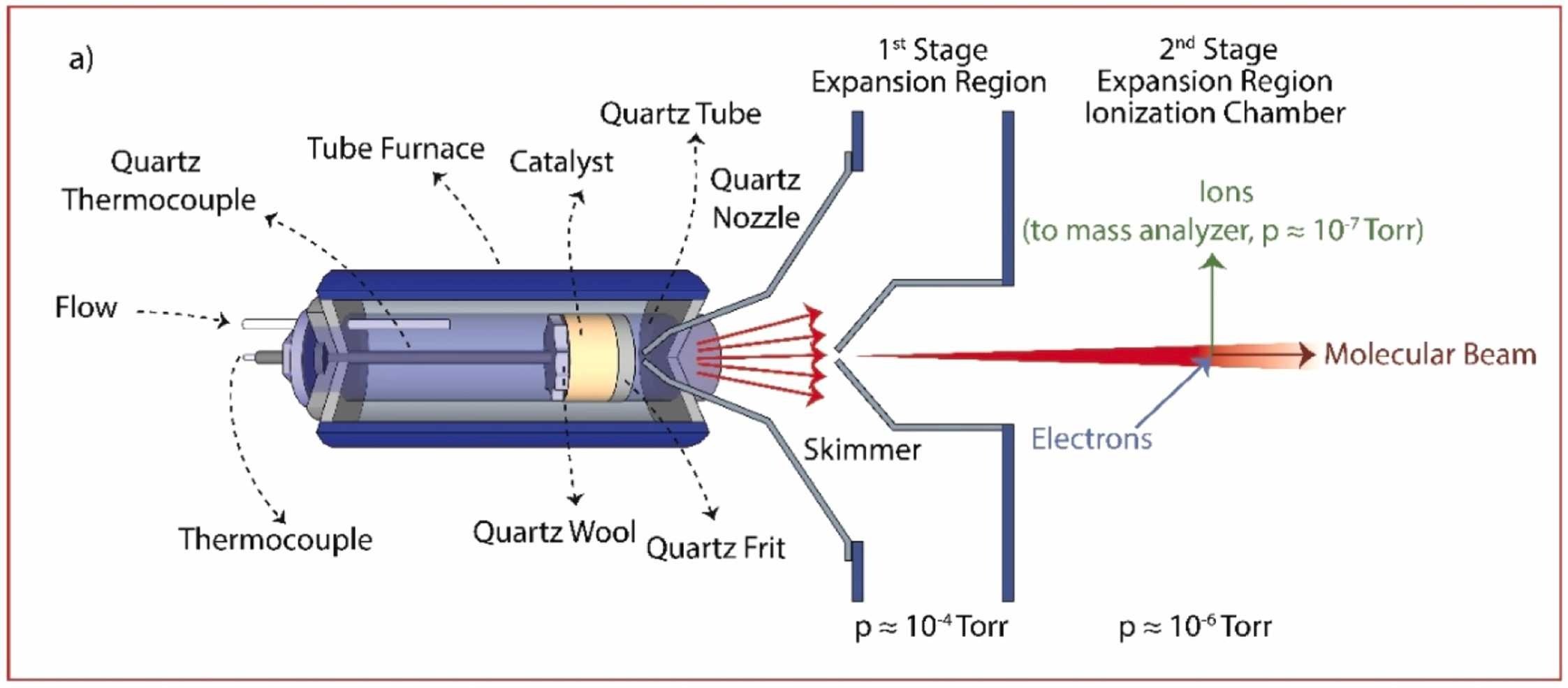
CRF researchers Nils Hansen and Emma Litzer together with colleagues Jawaher Mosrati, Thomas Bierkandt, Markus Köhler (all DLR Stuttgart), and Soufiane Bahou, Malte Wasgien, and Ali Abdel-Mageed (all Leibniz Institute for Catalysis), published a paper on “Real-Time Monitoring of CO2 Reduction on Supported Catalysts Using Near-Surface Molecular Beam Mass Spectrometry (ns-MBMS) ” in the “Journal of CO2 Utilization”.
Using near-surface molecular-beam mass spectrometry (ns‑MBMS) as a high-sensitivity, minimally perturbative, real-time diagnostic for heterogeneous catalysis under near-ambient pressure, the research team tracked CO2 hydrogenation and reduction over two well-characterized Ru/TiO2 catalysts with intentionally different selectivity—one favoring methanation and one favoring reverse water-gas shift (RWGS)—and directly observed temperature- and time-dependent product evolution in the near-surface reaction zone. Their approach captured previously unreported near-surface products/intermediates, including detectable CO during methanation-selective operation and transient C2H4, and revealed unexpected low-temperature H2 uptake on high-specific surface area (SSA) Ru/TiO2 consistent with a catalyst/support reduction processes. These results enhance our understanding of oxide-supported catalysts for CO2 activation and could pave the way for the development of new catalysts that enable chemical production from CO2.
For more details visit: https://doi.org/10.1016/j.jcou.2026.103404