
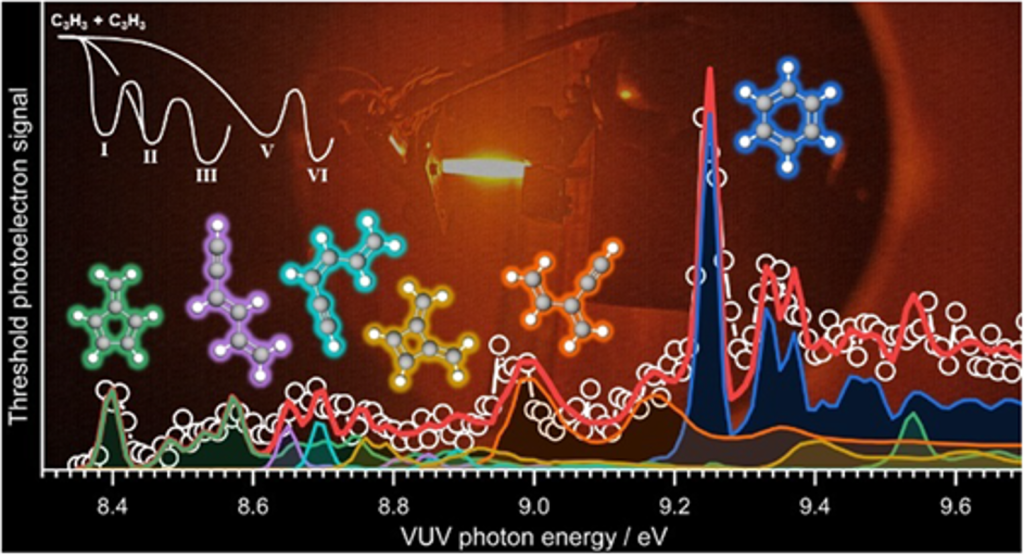
The formation of the first aromatic ring is a crucial step in the production of soot from combustion of aliphatic fuels. As a long history of CRF research shows, reactions of resonance-stabilized radicals, especially the propargyl radical, are key participants in that step. CRF researcher Nils Hansen, together with colleagues from the DLR for Combustion Science and the Swiss Light Source, have carried out a detailed investigation of a crucial ring-forming reaction, published as “Resolving C6H6 Isomers from the Propargyl Self-Reaction at Combustion-Relevant Temperatures by PEPICO Spectroscopy” in The Journal of Physical Chemistry A. In this work, the authors investigated the propargyl self-reaction experimentally by flash pyrolysis in a resistively heated silicon carbide microreactor at combustion-relevant temperatures of 1000 and 1190 K and at pressures near 10–20 mbar. Using photoion mass-selected threshold photoelectron spectra (ms-TPES) obtained with photoelectron photoion coincidence (PEPICO) techniques, the authors identified six C6H6 species: 2-ethynyl-1,3-butadiene, benzene, fulvene, cis- and trans-1,3-hexadien-5-yne, and 3,4-dimethylenecyclobutene. They further determined their branching ratios by least-squares fitting a linear combination of individual reference spectra to the experimental mass-selected photoelectron spectrum of m/z 78 and compared the results of theoretical predictions. The branching among these products is important for predicting the progress along the molecular weight growth path that leads to soot.
For more information: https://doi.org/10.1021/acs.jpca.6c03346