
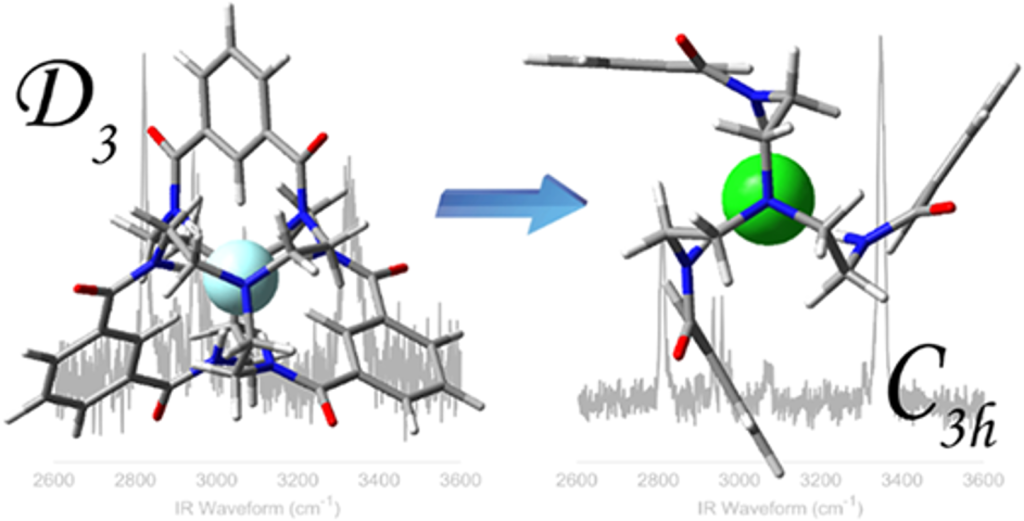
Molecular cages that sequester certain ions can be important for designing new strategies for selective capture of critical elements from aqueous solution. Using advanced theory and unique spectroscopy methods available at Sandia, CRF researchers Tim Zwier, Chin Lee, and Kendrew Au, together with Sandia colleague Jessica Rimsza and collaborators from LANL, Texas A&M, and the University of Kansas, directly observed how molecular cages alter their shape in order to bind different sized ions. This work, published in the article “Adaptive Halide Binding with Anion Size: Triggering Chiral D3 to Trigonal Prism Changes in a Molecular Cage” in the Journal of the American Chemical Society, includes IR spectroscopy and structural analysis of the halide ions F−, Cl−, and Br− bound inside a bicyclic amide-based cryptand cage under cryo-cooled conditions in the gas phase. They used IR-UV double resonance methods to record infrared spectra of the cryo-cooled gas-phase ions in the hydride stretch and fingerprint regions and compared their results with first-principles predictions of the infrared spectra of calculated candidate structures to make structural assignments. All three halide ions embed themselves inside the cages and adopt high-symmetry structures that optimize the six hydrogen bonds to the ion. The small fluoride ion (F–) leaves enough room in the cage for the three aromatic rings to form three secondary H-bonds with the F–, forming a D3 symmetry propeller-like structure, while the larger Cl– and Br– ions cause the aromatic rings to rotate so that they are tangential to the ions, forming a C3h symmetry, paddlewheel geometry.
For details: https://doi.org/10.1021/jacs.6c11035