
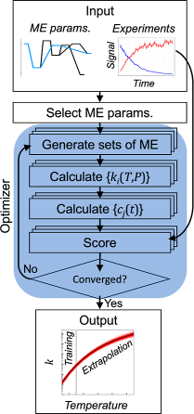
Coordinating effort across modeling, experiment, and theory is a powerful paradigm for discovery of fundamental interactions within complex reaction systems. Linking the experiment reliably to the most fundamental explanations can be challenging, however. CRF researchers Clement Soulié, Judit Zádor, and Leonid Sheps have taken an important step towards making these links more direct with their paper “KiMecO: A Kinetic Mechanism Optimizer for Experimentally Constrained Master Equation Models” published in The Journal of Physical Chemistry A. This paper introduces KiMecO, an uncertainty informed, master equation based kinetic mechanism optimizer that constrains the rate coefficients of a “submechanism” – a subset of the set of reactions that would govern a full hydrocarbon oxidation system – against concentration–time profiles of multiple species across multiple conditions in controlled experiments. It leverages machine learning and parallel computation to explore the sensitive master equation parameter space, a physically more fundamental description than rate coefficient parameterization. Constraints at this level enforce physically consistent correlations among rate coefficients. Use of the KiMecO framework on the reaction sequence initiated by the ethyl + O2 reaction shows that ensembles of master equation models are generally more robust than single models and that they enable uncertainty analysis of the optimized rate coefficients.
For more Information: https://doi.org/10.1021/acs.jpca.6c04372