
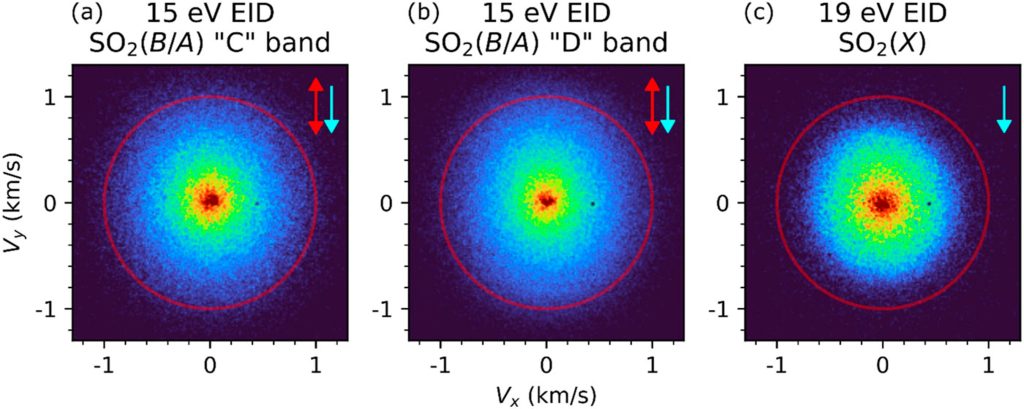
The details of electron interactions with excited-state molecules can be important in plasma processes but are experimentally elusive. CRF researchers Jonathan Frank and Dave Chandler, together with postdocs Haw-Wei Lin and Eric Smoll, developed a way to measure these interactions and employed it in their paper “Electron-ionization-dissociation dynamics of laser-excited SO2 (B 1B1/A 1A2) studied using velocity map imaging,” published in “The Journal of Chemical Physics”.
In this paper, the authors report the development of a pump–probe velocity map imaging (VMI) apparatus, where laser-excited molecules in a molecular beam subsequently interact with a dissociating electron beam. The product ions were probed using a calibrated VMI mass spectrometer to report absolute cross sections and information on the dynamics of the dissociation reactions. The authors demonstrated the apparatus on the electron-ionization-dissociation (EID) process of SO2 molecules excited to the electronically mixed Clements’ manifold B 1B1/A 1A2. Compared to ground-state SO2 molecules, the authors observed that for the state-selective EID formation of SO+ cations: (a) the thermodynamic threshold is lowered by the energy of the electronic excitation and (b) the partial cross sections with equivalent total energy are enhanced by factors of 2–4 for two distinct vibrational bands of the Clements’ manifold. Finally, the VMI images revealed that the SO+ fragments from the electronic excited states of SO2 are formed with kinetic energies up to 0.5 eV, whereas those from the ground state are predominantly below 0.2 eV. The change in the kinetic energy distribution is attributed to intramolecular vibrational relaxation and molecular geometry changes on the lower adiabatic surface of the Clements’ manifold, which shift the Franck–Condon region of the dissociative cationic state.