
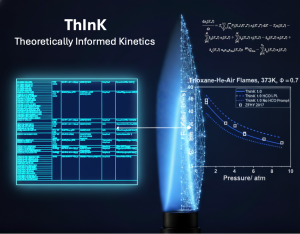
CRF researchers, along with colleagues from Argonne National Laboratory, University of Colorado Boulder, Southeast University Nanjing, Columbia University, Polytecnico Milano, Brown University, Baylor University, and the Technical University of Denmark, have developed a theory-informed kinetics model (ThInK) for the small molecule chemistry (H2 and C1 – C3 species) that forms the core of understanding combustion. This model is a landmark achievement because it employs, to a degree unprecedented in combustion modeling, accurate direct theoretical predictions for reaction rate coefficients, thermochemistry, and transport parameters. It fulfills one vision of the late Jim Miller, a longtime CRF researcher and giant in theoretical chemical kinetics for combustion (see https://doi.org/10.1016/j.pecs.2020.100886). The robustness and broad applicability of this kinetics model, which was developed over the course of several decades, are illustrated through predictions of flame propagation and autoignition behavior.
Stephen J. Klippenstein, Raghu Sivaramakrishnan, Nicole J. Labbe, Yujie Tao, Michael P. Burke, Sarah N. Elliott, C. Franklin Goldsmith, Clayton R. Mulvihill, Ahren W. Jasper, Branko Ruscic, David H. Bross, Peter Glarborg, Nils Hansen, Judit Zádor, James A. Miller, “Theoretically Informed Kinetics (ThInK): Establishing a modern C0-C3 mechanism for combustion modeling,” Combustion and Flame 282, 114501 (2025). https://doi.org/10.1016/j.combustflame.2025.114501