
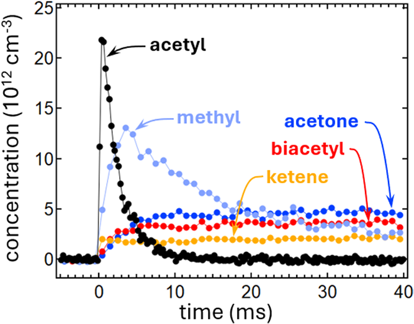
The pressure dependence of chemical reactions shows the interrelationship between collisional energy transfer and reactivity and is an important window into understanding how energy flow affects reaction systems. CRF researcher Leonid Sheps, together with colleagues from the University of Texas at El Paso and Argonne National Laboratory, carried out an investigation of pressure effects on reactions of an important radical intermediate, acetyl radical. They published this work in an article entitled “The Photoionization Spectrum of the Acetyl Radical and the Kinetics of Its Unimolecular and Bimolecular Reactions at Elevated Pressures” in The Journal of Physical Chemistry A. They provide a combined modeling and experimental analysis of the comprehensive network of acetyl (CH3CO) unimolecular and bimolecular kinetics at 500 kPa and 300–366 K. Because CH3CO is relatively weakly bound, it exhibits a rich interrelationship between unimolecular and bimolecular reactions that is highly sensitive to the effects of collisional energy transfer. CH3CO was generated by acetaldehyde (CH3CHO) + Cl reactions, where the Cl is produced by pulsed laser photolysis of oxalyl chloride ((COCl)2) at 248 nm. The progress of reactions was monitored via multiplexed photoionization mass spectrometry, providing concentration–time profiles of CH3CHO, CH3CO, methyl (CH3), ketene (CH2CO), acetone (CH3COCH3), and biacetyl ((CH3CO)2). The concentration of CH3CO was quantified from time-resolved atom balance analysis. Because of the unavoidable contributions of secondary reactions, the detailed quantification of all relevant species is essential to enable reliable determination of the rate coefficients for the reactions of interest.
For more information: https://doi.org/10.1021/acs.jpca.6c05086