
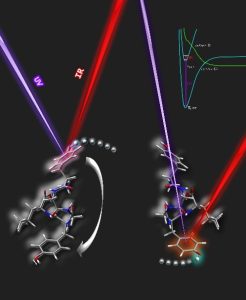
Controlling the course of a chemical reaction by mode-selective laser excitation is typically thwarted by the rapid delocalization of the energy, especially in large molecules. CRF researchers Tim Zwier, Kendrew Au, Chin Lee, and Kyung-Chul Woo, together with colleagues from Purdue University, University of Nevada, Reno, and Fairfield University, discovered a method for steering quantum tunneling by mode-specific excitation in a large pentapeptide ion, employing a two-stage excitation scheme. This work was published a paper entitled “Site-Specific and Mode-Specific Photodissociation of OH bonds in a Pentapeptide by Laser-Driven Tunneling through a Conical Intersection” in the Journal of the American Chemical Society. In this paper, the authors used an ultraviolet-infrared (UV-IR) double resonance excitation scheme to demonstrate both site- and mode-selective photodissociation of the O−H bond in either of the two tyrosine chromophores (Tyr, Y) in a cryogenically cooled, gas phase protonated pentapeptide ion [YGGYL+H]+ with 231 vibrational modes. Site-selective and mode-selective loss of the OH hydrogen atom is observed when both UV and IR excitation are on the same Tyr chromophore, with a mode-selectivity of greater than 100:1. This remarkable selectivity is possible because tunneling underneath the 1ππ*/1πOH conical intersection following OH(v=1) excitation is fast enough that it competes favorably over vibrational energy scrambling, making it possible to direct the tunneling with laser excitation and choose to fragment either OH bond in this large molecule with high fidelity.
For details: https://doi.org/10.1021/jacs.6c12616