
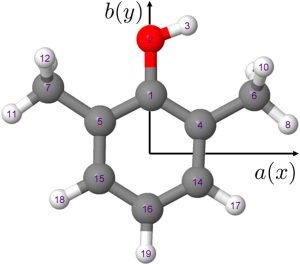
CRF researcher Timothy Zwier, together with Edwin Sibert from the University of Wisconsin-Madison, published a paper on “On the role of symmetry in quenching OH tunneling in 2,6-dimethylphenol” in “The Journal of Chemical Physics”, providing more detailed theoretical descriptions of recent experiments that were interpreted to show that certain symmetry states of neighboring methyl groups could ‘switch’ on or off quantum tunneling of the OH in 2,6-dimethylphenol (see earlier post here). They modeled the tunneling dynamics in 2,6-dimethylphenol, with its tunneling OH group and two coupled tunneling methyl internal rotors, using both a full, three-dimensional model and an adiabatic model in which the OH torsion is treated as the slow mode, to test the physical model they had used to interpret the observed broadband microwave spectrum in earlier work. Good agreement was found between the exact and approximate adiabatic models, with the exact model providing quantitative predictions of the energies and tunneling splittings of the full set of tunneling levels. The adiabatic model was developed to elucidate the key couplings that lead to the state-dependent quenching of the tunneling splitting, providing predictions about when this quenching will be important in other molecules undergoing multi-dimensional tunneling.
For more information: https://doi.org/10.1063/5.0339941