
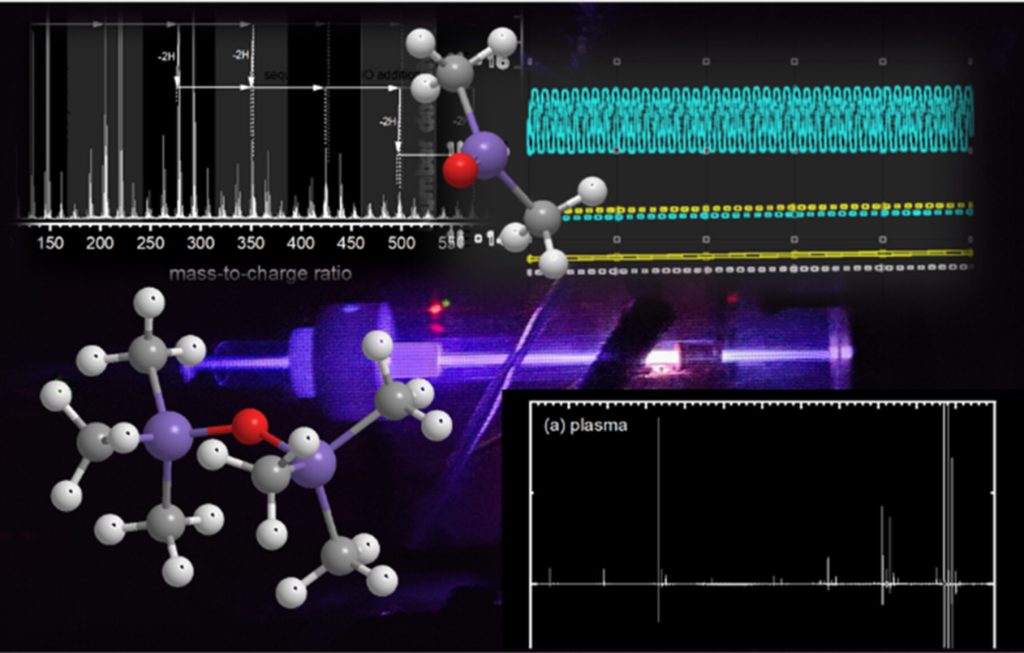
Siloxanes (organosilicon compounds with silicon–oxygen (Si–O–Si) structures) have a broad range of technology applications, and understanding their chemical transformations is important both for industrial uses and for managing their disposal. Emma Litzer and Nils Hansen, together with colleagues Tanvir I. Farouk, Prangan Nandy, Raziya S. Chowdhury and Shamia Hoque from the University of South Carolina, investigated plasma assisted transformations in a representative siloxane, reported in the journal Plasma Processes and Polymers on “Siloxane Decomposition and Clustering in Atmospheric Pressure Non-Thermal Plasma Discharge”. The authors analyzed the plasma-assisted decomposition and gas-phase polymerization of hexamethyldisiloxane [HMDSO, (CH3)3SiOSi(CH3)3] in an atmospheric-pressure dielectric barrier discharge by molecular-beam mass spectrometry with high mass resolution. This technique yielded detailed identification of reactive intermediates and oligomeric products that helped characterize the dependence of fragmentation and recombination pathways on plasma and reactor conditions. A chemical kinetic model incorporating a simplified four-step polymerization sequence of dimethyloxosilane (CH3SiOCH3) up to C8H24Si4O4 reproduces the experimentally observed oligomer growth trends. The mechanistic insight into plasma-induced precursor reformation and the early stages of polydimethylsiloxane formation under atmospheric-pressure conditions will enable better engineering of siloxane polymers.
For details: https://doi.org/10.1002/ppap.70197