
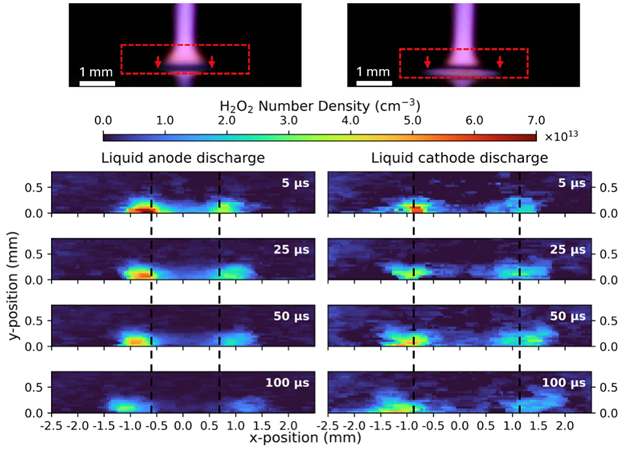
In order to better understand the mechanism for plasma-induced formation of hydrogen peroxide (H2O2), a key reactive species in plasma processing, Jonathan Frank, Erxiong Huang and Sebastian Pfaff from the CRF, with colleagues Jae Hyun Nam and Peter J Bruggeman from the University of Minnesota, carried out spatially and time-resolved measurements of gas-phase H2O2 density at a plasma-liquid interface. This work was published in an article entitled “Hydrogen peroxide formation mechanisms in liquid anode and cathode discharges” in the journal Plasma Sources Science and Technology.
How hydrogen peroxide is formed in non-thermal plasma–liquid interactions has been a controversial question; the fact that the production rate strongly depends on the polarity of the liquid electrode has been particularly hard to explain. In this paper, the authors describe photo-fragmentation laser-induced fluorescence measurements of the gas phase H₂O₂ density at the interface of a pulsed helium plasma jet impinging on a liquid electrode, which is found to be similar for both electrode polarities. These results are contrasted with complementary measurements of the liquid-phase H2O2, which shows a factor of ten difference between polarities. This contrast can be explained by greater production of aqueous hydroxyl radical, the reactive precursor for H2O2, when positive ions strike the liquid as opposed to negative ions. The results identify this ion-driven liquid-phase chemistry as the dominant mechanism responsible for the polarity dependence in H₂O₂ synthesis by plasmas in contact with an aqueous electrode.
For more details: https://doi.org/10.1088/1361-6595/ae50b4