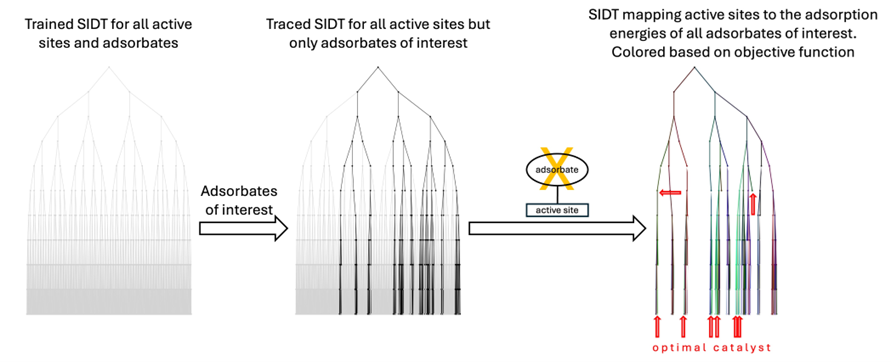
Judit Zádor co-organized this year’s “Faraday Discussion on Bridging the gap from surface science to heterogeneous catalysis” that was held in London, United Kingdom, April 20th-22nd. At this meeting she and fellow CRF researcher Matthew Johnson presented their development, with collaborator Richard West from Northeastern University, of an interpretable machine-learning framework using Subgraph Isomorphic Decision Trees (SIDTs) that can predict adsorption energies of carbon, hydrogen, oxygen, and nitrogen containing adsorbates on arbitrary catalytic surfaces and can enable generative design of catalyst active sites. Trained on 344,756 monodentate adsorption configurations extracted from the Open Catalyst 2020 database the SIDT achieves strong predictive performance along with well-calibrated uncertainties. The key innovation is to use SIDTs as generative models that return interpretable substructure distributions—not just sampled candidates. This framework enables fast, interpretable adsorption-energy prediction across a vast catalyst space, supporting efficient, constraint-aware catalyst optimization.
For more details: https://doi.org/10.1039/D5FD00143A